
The Things you know About Cardiac CT/FFR and the Top 5 Things You Need to Know for Optimizing Your Cardiac CT Program

By now, you have learned that the use of cardiac CT is a Class I recommendation by the American College of Cardiology for diagnosis coronary artery disease. CCTA/FFR has higher diagnostic performance.

And you think this is great because you know that:
1) cardiac CT is a great tool for patient care and plus patient wellness and prevention
2) your cardiologists are eager to offer cardiac CT for your community
3) the CT scanner is expensive
4) the staff are expensive
5) the scan is much faster, easier, and less expensive process for patients
6) it is a less complex procedure than a cardiac cath.
7) CT scanning requires fewer expensive resources from your health care organization.
8) And you know that providing cardiac CTA has a number of critical pre-scan elements that need to be completed for quality results

So how do you ensure that you have a program that can manage the volume you project and is cost-effective so that you have a rapid return on your investment? Do these 5 things to improve efficiencies of your cardiac CT program.

  1. Develop your standardized ordering CCTA referral/order process- ensure that the process is easy and streamlined for ordering physicians
  2. Create dedicated scheduler – who can interface with ordering physician offices and nurse navigator to schedule patients quickly and appropriately
  3. Dedicated nurse navigator – having a navigator is central for supporting the physicians, scheduler, patients, and the CT scan team with appropriate prep and protocols
  4. Develop cardiac CT technologists who can determine appropriate scanner protocols, reprocess images as required, and submit quality studies for FFR
  5. Create your cardiac CT physician reader pool- appropriately trained readers with radiology support for over reads is critical for ensuring quality outcomes for your patients

While knowing your cardiac CCTA program is a pivotable element of cardiology care, creating a high quality can seem overwhelming. Pulse Imaging Consultants can help you get past overwhelming and get to productive high quality patient care.

For more information on the impact of CCTA/FFR programs on patient care and developing a successful program, see the HeartFlow sponsored SCCT webinar


Watch Here


Sign up

to stay updated on news from pulse

Newsletter - Article

This field is for validation purposes and should be left unchanged.

Featured Articles

Invasive diagnostic coronary angiograms have been the backbone of coronary artery disease (CAD) assessment for decades. However, many cardiology experts are predicting the rapid growth of coronary CT angiography (CCTA) will very soon eliminate the need for catheterizing patients just for diagnostic purposes. Rather, invasive cardiac catheterization will be used just to perform percutaneous coronary intervention (PCI), but we will screen and make treatment decisions based on CCTA.

Thought leaders in cardiac CT have been discussing the potential of such a trend for years, and now CT hardware, software and artificial intelligence (AI) have all caught up enough that it truly seems possible. In fact, interventional cardiologists and cardiac surgeons have now joined cardiac imagers in support of CCTA.
New CCTA technology, especially AI-driven advances in automation thanks to fractional flow reserve (FFR-CT) and soft plaque analysis, has given noninvasive CT diagnostic capabilities far beyond those of invasive angiography.

In addition, CCTA can support rural hospitals that don’t have cath labs and decrease the number of patients that require transfer to tertiary centers through more precise diagnostics of NSTEMI. The combination of AI and CCTA could help in those areas.

Some CT scanners are now more affordable and versatile pieces of equipment for hospitals and physician practices to obtain and operate. The newer software and AI tools streamline the training and workflows, providing efficient tools for diagnosis of coronary artery and valvular conditions.

Does your practice have the best options for cost effective identification of coronary artery disease?

Start by reviewing: CCTA Reimbursement Updates for 2025 below and align your charges as seen in 1, 2, 3.

U.S. CMS doubles reimbursement for cardiovascular CT services

reimbursement for cardiovascular CT services
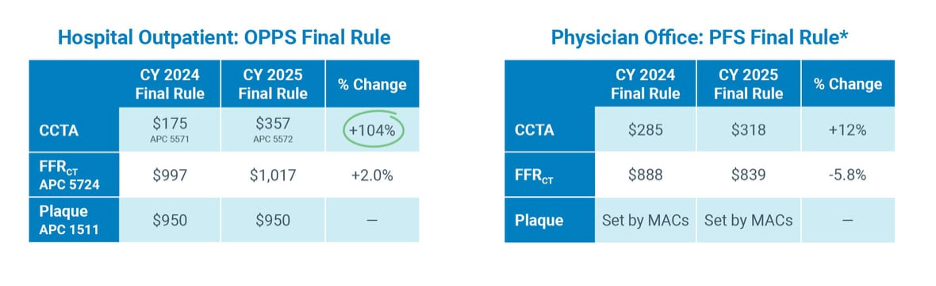
The U.S. Centers for Medicare and Medicaid Services (CMS) has released its final rule for 2025 reimbursement: Coronary CTA (CCTA) has been elevated to a new Ambulatory Payment Classification (APC) classification, doubling reimbursement for this procedure in the hospital setting (OPPS) and increasing payment in the physician office setting (PFS) effective January 1, 2025. [1],[2]
  1. This highly anticipated update doubles the CCTA payment rate from $175 to $357.13, aligning Medicare reimbursement more appropriately with the value CCTA provides in cardiac care. This is a win for U.S. providers as well as the entire cardiac imaging community, ultimately improving patient access to this essential diagnostic tool.
  2. What should hospitals do now that CMS has approved this change?
    Hospitals should use the cardiology revenue code (0480) for CCTA services, when appropriate.
  3. New Category I CPT code issued for AI-enabled coronary plaque analysis software
The American Medical Association (AMA) has issued a new Category I CPT code for artificial intelligence (AI) based platforms that quantify coronary plaque buildup in imaging results and identify signs of coronary artery disease (CAD).[3] The update, scheduled to take effect in January 2026, covers AI offerings from multiple companies, including HeartFlow, Cleerly and Elucid. These technologies work by evaluating coronary CT angiography images and then alerting clinicians of any findings that represent CAD and high-risk features for heart attacks.

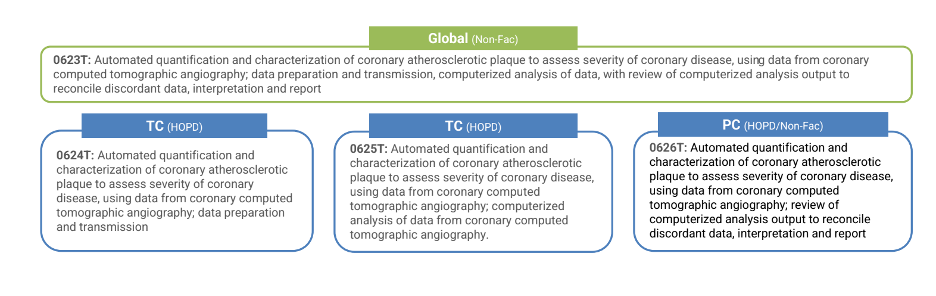
Coding: Plaque Analysis will be billed with the 4 CPT Category III codes approved for automated plaque analysis, effective late November 2024

CPT Category III codes

Announcement comes days after CMS expanded Medicare coverage for these platforms.

October has been a historic month for AI-powered coronary plaque analysis. Just days ago, the finalized a new local coverage determination (LCD) that expanded Medicare coverage for these same technologies. Four of seven Medicare Administrative Contractors (MACs) agreed to the updated policy, which went into effect on Nov. 24.

Now that you see how to improve your revenue capture in 3 simple steps, can the rest of your CCTA program performance use a boost in revenue performance through improved efficiencies?

Pulse Imaging Consultants has more ways to improve your Cardiac CTA program, improving throughput, patient and provider satisfaction, and improving overall performance. Contact us if you would like to know more.

[1] https://scct.org/news/news.asp?id=685976

[2] https://www.federalregister.gov/documents/2024/11/27/2024-25521/medicare-and-medicaid-programs-hospital-outpatient-prospective-payment-and-ambulatory-surgical

[3] https://www.ama-assn.org/system/files/sept-2024-summary-of-panel-actions.pdf

[4] https://scct.org/page/HOPPScy25?_zs=6VO6X&_zl=DemW4